
Wednesday, December 9, 2015

Sunday, November 29, 2015
Beekeeping Talk and Gadgets
An amazing bunch of curious, smart and inventive beekeepers gathered together at our last meeting to discuss the latest news and to share ideas and home-made gadgets.
Updates
The U of MN Beekeeping for Northern Climates classes continue to be very popular with the November Year 1 class drawing some 210 people. You may still be able to register for the Year 1 Class and the Year 2 class that will be in February.
The U of MN has updated their disease and pest booklet, and you can download it here. They have lowered the threshold for treating mites. Jim for Nature's Nectar reports of European Foulbrood around the state.
The U of MN Bee and Pollinator Research Lab is fundraising with a Paver Campaign. For $250 you can immortalize yourself and support this important research lab.
Show-and-Tell
Bob showed us his stainless steel entrance reducer. It's a beauty with slots that the bees can get through and the mice can't. I used one this fall on a hive that I could not fit the regular entrance reducer. I just shut off about half of the holes to reduce cold winter winds with duct tape (what else?). Bob is selling these for $5.


Laurie shared her "flow hive" with the club.
The theory is that the bees fill the cells with honey, they are capped and then the beekeeper inserts a lever to "open" the cells so the honey flows out. It will be interesting to get Laurie's report after she uses the flow hive. A few questions raised about the flow hive were "how do you know the moisture level of the honey?" and "how does it work when gunked up with propolis?". Stay tuned, we shall see!
 |
| Flow Hive Frame |
DO NOT TRY THIS AT HOME???
There was of talk on vaporizing oxalic acid with home made gadgets.
 |
| Steve's vaporizer |
 |
| Liz's method |
A safer and easier method may be to visit Jim at Nature's Nectar.
A treatment-free way to reduce your mite load is through brood break. Here is the "gold standard" in splitting from Mel Disselkoen using nucs. I use the "walk away split" to achieve a brood break, and to avoid spending money on a new queen. You will sacrifice some honey for the season from that hive, but you should end up with a strong colony that will build up fast.
Walk-Away-Split
- Split a strong colony, and let the queenless split make its own queen.
- You can use a nuc for this. Make sure you have a frame of eggs and two frames of brood, capped and uncapped, and a couple frames of pollen and honey. Remember brood in the center. Have loads of nurse bees covering the frames. Give them some sugar water, and leave it alone for 4 weeks. When you check back, you should see eggs.
- It is important to have 2 weeks of 70 degree days before doing a walk-away-split. This is to ensure drones are present.
Attention turned to wax melting. Adrian's shared his "Presto Pot" method.

Wax is melted in the Presto pot, then strained through old sweatshirts. The wax comes out clean and yellow. This is a good method because it is self contained and can be done in an outdoor building. Remember, wax is extremely flammable, so it is best to avoid using your stovetop and oven. I prefer the solar melter method. The solar melter is limited because you need sunny, warm days to melt wax, but it works great with very little fuss. I put my wax on top of a strong paper towel that is held to the top of a small bucket with a rubber band. The bucket has a bit of water in the bottom. The wax melts, and you remove it from the water and compost the paper towel. No matter what kind of brown, burr wax you put in there, it comes out a beautiful bright yellow color.

What happens when you extract your honey and find that the water content is over 18.6%? Quick make mead! Or, you can use Tom's Bucket Honey Dryer! Utilizing an aquarium air pump, some PVC with brass fasteners, and a fan, Tom showed us how we can make our own "honey volcano" to dry out your honey to an acceptable level.


Thank you for another great meeting and looking forward!
December 20th join us to hear Crystal Boyd from the MN Department of Natural Resources.
January 2016 meeting Pesticides: What Beekeepers Need to Know
March 8 2016 People For Pollinators education day
~mf~
~mf~
Sunday, November 15, 2015


Sunday, October 11, 2015
Comments Needed by Oct 21, 2015
North Star Solar is applying for a site permit in Chisago County. This will be a 800+ acre area that is currently in corn/soybean agriculture use.
This huge solar array will be underplanted with native plants in varying sizes to fit under the array. I have seen the planting list and it is very appropriate and will provide high quality nectar and pollen. This will be a huge boon to pollinators in an area that is currently devoid of pollinator habitat.
The last public hearing before the Public Utilities Commission is Wednesday October 7th in North Branch. They are accepting verbal and written comments at that time. The written comment period endsOct 21. Please show your support by writing a comment, it goes a long way.
Attached is the PDF will the full docket information, and here is where you can go to submit comments: MN Public Utilities Commission - Speak Up!
Thanks!
Marcie
(posted by ELW)
Saturday, September 19, 2015
How to get neonicotinoids out of the water
"...Center for Food Safety offers eleven policy
recommendations, mostly directed to EPA:
-
Suspend neonicotinoid insecticide registrations due to their
unreasonable adverse effects in aquatic ecosystems.
-
Adopt rigorous national aquatic contamination thresholds to
avoid lasting effects on aquatic invertebrates specifically: 0.2 ppb
for short-term acute exposures, and 0.035 ppb for long-term
chronic exposures.
- Eliminate the “Coated Seeds” exemption from pesticide registration requirements.
- Stop classifying neonicotinoids as “reduced risk” pesticides and fast-tracking their registrations; also end Conditional Registrations for them.
- Use more representative aquatic test species and long-term mesocosm studies for determining biological risks.
- Comply with Section 7 of the Endangered Species Act in order to protect threatened and endangered aquatic-dependent species and their habitats.
- Drastically change neonicotinoid product labels for all uses that foreseeably will impact aquatic ecosystems.
- Conduct more systematic research and monitoring on the effects of aquatic contamination, including the human health implications.
- Marine protection campaigns should specifically address neonicotinoid contamination.
- Apply the Clean Water Act to initiate remedial actions.
- Take action at the State and local levels to protect affected waters."
How to contact our regional Enviromental Protection Agency office:
Region 5 (Illinois, Indiana, Michigan, Minnesota, Ohio, Wisconsin)
77 W. Jackson Boulevard
Chicago, IL 60604
Phone: 800-621-8431 (Inside Region 5)
Phone: 312-353-2000 (Outside Region 5)
Web Site: www.epa.gov/region5
Neonicotinoid class of insecticides include:
CLOTHIANIDIN
DINOTEFURAN
IMIDACLOPRID
THIAMETHOXAM
ACETAMIPRID
NITENPYRAM
NITHIAZINE
THIACLOPRID
SULFOXAFLOR
Products containing these neonicotinoid chemicals:
http://www.prairienursery.com/customer-care/product-information/documents/neoniclist.pdfOkay now its YOUR TURN to TAKE ACTION whether its by getting on the phone, writing an email, culling products from your aunt's garage, educating your church group, planting a buffer strip etc.
Thank you
ELW
Thursday, September 17, 2015

Thursday, September 3, 2015
Beek to Beek Recap
A group of 45 or more creative thinking beekeepers got together on August 17, 2015. Attendees were receptive to new ideas and methods and enthusiastic about helping out a peer if they could. Here's some of the many member contributions. If you want more information about the technique or gizmo please come to a meeting and meet the beekeeper who will be happy to explain further.
Bob: showed a feed sack swarm catcher made with a thick telegraph wire rim hooked into top of long ½" electrical conduit pole, admits telegraph wire is no easy find.

Bob: brought a box feeder tray with different sized mesh openings sized for smushing in a pollen patty or setting on an upturned ball jar syrup feeder with holes poked in the lids. Hive body shell will contain all.

Bob: carries a portable hive stand to his out yards made of 2x4's mostly, with pivoting legs.

Mary: is willing to coordinate a bulk Russian order and intents to start a "What to do with my Russians this month" blog (says it'll be a lot of: "get your favorite beverage, sit back and put your feet up".)
Randy: uses a slow cooker to heat wax and paint over foundation. Ask your spouse first.
Rick: uses a beeswax candle or burr comb to rub over corners and edges of foundation where manufacturer missed waxing. Says "Bees will take care of the middle."
Jerry: does same but also adheres it with a sweep of a heat gun.
Lee: uses industrial heat gun to decap frame. When cappings melt off to cell wall, move on. Easy to decap even low spots this way. Honey stays cool.
Eric: also uses this method. Says it takes 15 min to do a super and leaves virtually no wax in the honey.
Eric: made a production style reusable queen releasing system. Its first a 3" +/- wood frame with side hole for queen cage. Frame is set over ideal area in brood nest. Push in cage slides inside frame. Once queen walks through wood hole, push in cage is set down. Wood frame is then removed to be used in next hive with new push in cage insert. If you make this as nice as Eric's you could also store jewelry in it off season.
Gary: made a low tech cappings extractor by cutting the bottom end off a gallon milk type jug. Simply use jar like a funnel over honey container, drop in cappings, they'll restrict the opening and honey will drain through the gaps. Brilliant!
Adrian: recommends Mann Lake's One Handed Queen Catcher because it allows marking or clipping with your other hand. http://www.mannlakeltd.com/



Bob: showed a feed sack swarm catcher made with a thick telegraph wire rim hooked into top of long ½" electrical conduit pole, admits telegraph wire is no easy find.

Bob: brought a box feeder tray with different sized mesh openings sized for smushing in a pollen patty or setting on an upturned ball jar syrup feeder with holes poked in the lids. Hive body shell will contain all.

Bob: carries a portable hive stand to his out yards made of 2x4's mostly, with pivoting legs.

Mary: is willing to coordinate a bulk Russian order and intents to start a "What to do with my Russians this month" blog (says it'll be a lot of: "get your favorite beverage, sit back and put your feet up".)
Randy: uses a slow cooker to heat wax and paint over foundation. Ask your spouse first.
Rick: uses a beeswax candle or burr comb to rub over corners and edges of foundation where manufacturer missed waxing. Says "Bees will take care of the middle."
Jerry: does same but also adheres it with a sweep of a heat gun.
Lee: uses industrial heat gun to decap frame. When cappings melt off to cell wall, move on. Easy to decap even low spots this way. Honey stays cool.
Eric: also uses this method. Says it takes 15 min to do a super and leaves virtually no wax in the honey.
Eric: made a production style reusable queen releasing system. Its first a 3" +/- wood frame with side hole for queen cage. Frame is set over ideal area in brood nest. Push in cage slides inside frame. Once queen walks through wood hole, push in cage is set down. Wood frame is then removed to be used in next hive with new push in cage insert. If you make this as nice as Eric's you could also store jewelry in it off season.
Gary: made a low tech cappings extractor by cutting the bottom end off a gallon milk type jug. Simply use jar like a funnel over honey container, drop in cappings, they'll restrict the opening and honey will drain through the gaps. Brilliant!
Adrian: recommends Mann Lake's One Handed Queen Catcher because it allows marking or clipping with your other hand. http://www.mannlakeltd.com/

Adrian: found a helpful free Bee Health App. from the government in Alberta, Canada.
Adrian: also uses a programmable outlet thermostat for regulating the electric heater and dehumidifier fan where he stores honey supers. Its available through this link and at Home Depo.
Gary: uses a canvas portable ice shack with floor for his super conditioning room.
Bob: to melt a crystallized bucket of honey, uses a trouble light (sold in the auto departments as a cord, light socket and switch, all in one piece) and a 100 watt bulb.
Lee or maybe Brady: described his use of a 60W bulb, thermometer and fan to condition their supers before extracting.
Bob and Lee: uses a heat sensing gun (optional to using a thermometer) to get a measurement of the honey temp to make sure all is warm enough for extracting or bottling.
If you go over 115 degrees you will degrade the taste of the honey and destroy some of the good enzymes. Said these cost around $29 bucks.
Bob: dries out high moisture content honey by stacking the supers alternately, running a heat fan, and dehumidifier, in an enclosed room for a few days before extracting.
Rick: says an indoor/outdoor remote thermometer is helpful in checking status of his super conditioning area.
Tom: got a used $40 commercial tower proofing oven for his supers. Works like a charm.
Bob: described his winter top cover moisture venting box with upper entrance. Joanne swears by them.
Dan: adds Bilt Rite on top for its heat conductive properties.
Bob: says Dan (Miller Manufacturing for Fleet Farm) now manufactures his top box.
Joanne: recommends metal screen not plastic as mice can chew through plastic screen.
Elizabeth: showed her version of the Ed Simon Winter Feeder Bramble box. If you use ½" hardware cloth in the center you can do baggie feeders or lay over a tighter mesh when you want the bees to stay contained below to feed through the screen for thicker slush/fondant or a pollen pattie.To buy new go to: WW-9909 Winter Top - Bramble http://www.thebeeshed.com/documents/General_Price_List_2015-05-01.pdf

David: said cappings, even several years old, are fine to feed bees if not fermented. Much easier than extracting them.
David: advised when using formic acid/MAQS keep screened bottom board open.
David: commented that Oxalic acid doesn't permeate cells so need to do again after brood emerges or wait for brood break.
Jerry: says you can also combine oxalic acid with sugar syrup and do the seam drizzle method but its less effective. Warns to check the label before buying wood bleach oxalic acid from a paint store to make sure its the same stuff.
Mike: filters wax by simmering and then letting it settle. Wax floats to top, impurities can be scraped off. Repeat as necessary.
Jerry: says the sun will bleach wax.
Adrian: uses saran/plastic wrap or clingfilm (if you're from the other side of the pond) to take off the floating layer of wax on his honey settling buckets.
Rick: cuts strips off political yard signs (of opposing candidates of course) across the grain/tubes and staples them to the deep side of his inner covers to add ventilation. This also gives height and ventilation for using the inner cover as a feeder tray for syrup baggies or flipped for fondant and eliminates the draft caused by a typical upper entrance hole.
Rick: has found duck tape around top inner edge of boxes miraculously keeps bees from wanting to boil out and get squished.
Rick: recommends finding a woodworker to get a dense hardwood scrap to make into your entrance reducers. Mice can't chew though woods like Ipe and Purple Heart.
Rick: uses duck tape to reduce an entrance reducer on the fly.
Rick: says a paint mixer wand attached to a cordless drill works great for syrup making.
Rick: uses feed stimulants like lemongrass, spearmint, wintergreen and a pinch of trace mineral salts (available from hunter supply shops) in his feeders.
Rick: uses a sign cutting bit to turn political signs (again opponents are best) into the disc style entrance reducers. Especially satisfying if your bees have nosema.
Adrian: said his North facing nucs were weaker than his South facing nucs. He noticed at the first inspection that there was more ice in the North facing nucs than the South facing ones, and believes this inhibits the build-up.
Rick: says to get a lighted magnifying glass to help see eggs. No more struggling on overcast days.
Rick: recommends a galvanized pail for your smoker instead of melting up your car. He didn't say how he knew this.
Rick: uses a wood plug to snuff his smoker out. Reduces time and wasted smoker fuel.
Rick: uses a frame spacer in each hand for speed. Sounds like a good idea if you are a multi-armed Indian goddess. Not sure how he manages, but there may be stuff about him we don't know yet.
Rick: carries just-in-case supplies like a queen cage, shims and an extra hive tool. I carry a just-in-case beer.
Rick: revealed to many of us wondering --what the hidden properties of sumac berries are in smokers...He says the hairs on the berries exude a small amount of oxalic acid. When you smoke them you are giving a small vaporized dose to your mites. Those of us trying to raise bees and not mites should harvest Staghorn sumac berries when dry and not after rainy weather to get the most oxalic acid. Very cool.
Rick: carries a cappings scratcher to open capped honey cells if you want the bees to move it or to do drone brood removal. His tool box also includes a water mister bottle for quick clean-up of sticky honey hands and a frame hanger.
Tom: uses a section of a political sign to sheave his cappings scratcher. This guy is neat and probably swears a lot less than the rest of us!
Tom: has found the cheapest wood pellets do not contain glue and make good smoker starters. He also uses pine cones.
Tom: sprinkles cinnamon around the inner cover top to deter ants.
Tom: sprinkles moth balls around the ground outside of his hives to deter mice.
Tom: recommends a prybar sold by Woodcraft intended for removing trim as an inexpensive, quality hive tool. This might be it: http://www.woodcraft.com/product/856640/grip-9-stainless-steel-pry-bar.aspx
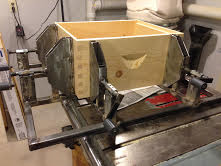
Randy: brought in several jigs for making boxes and hand holds all of which allow him to make and assemble woodenware inexpensively and with a lot of precision. He plans to show us some videos in November as we were running out of time.

Thanks to everyone for their generous input and support of each other. It is very nice to be part of this club. You make the difficult job of keeping bees alive, a lot easier.
btw Margot Monson, MS Entomology, beekeeper is coming Sept 21st. She says her "presentations have been emphasizing the less well known and appreciated native pollinators, that are often not recognized as beneficial, let alone as pollinators: flies, beetles, moths, social wasps, solitary bees and wasps, etc., and how important they are in creating the balance necessary to a healthy garden, that plant diversity will naturally establish insect diversity, eliminating for the most part serious pest problems." She will show her photos as a part of a power point presentation.
ELW
Subscribe to:
Posts (Atom)